Restaurant financials,
read like a briefing.
An in-house finance practice for restaurants — deterministic movement bridges, AI-written narratives that never invent a number, and a reconciliation quietly running in the background. The recoveries we surface along the way pay for the read.
Eleven things a
real weekly read surfaces — before month-end.
The best hospitality operators run at 8–14% EBITDA. The compression rarely comes from one big miss — it comes from a recurring set of small things that nobody sees because nobody is reading the right sources at the right cadence.
What moved this week — and why
Deterministic revenue, margin and channel bridges — with an AI-written briefing written over them. Every rupee in the narrative literally exists in the numbers; nothing is invented. Written to be forwarded without a single edit.
Settlement Variances
Aggregator payouts (Swiggy, Zomato) never match your POS sales — and most of that gap is expected, buried in commission, GST, and platform fees most owners never calculate. A real slice of it isn't structural — it's wrong commission tiers, auto-applied discounts, or cancelled orders billed as delivered. Catching the difference requires reconciling settlement reports before the weekly dispute window closes.
Supplier Overcharges
Vendors raise rates between invoices, swap SKUs, or invoice quantities not delivered. Every line is benchmarked against your contracted rate and yesterday's market price — overcharges come with a ready-to-send negotiation brief.
Reconciliation Gaps
When your sales records, accounting books and bank deposits do not agree, money slips through the gaps. Three-way reconciliation matches every transaction across all sources so nothing is missed.
Bank Deposit Shortfalls
Settlement fees, MDR, GST, and TDS are individually documented — but never linked back to the specific order or bill they came from. A single bank credit can quietly net out hundreds of transactions, so the only way to know if the deposit is correct (not just lower than expected) is to reconstruct expected vs. actual, order by order.
Card vs Bill Mismatches
Voided bills, missed tenders and cash-drawer shortfalls compound silently at the shift level. Even a few thousand a day represents lakhs a year per outlet.
Menu Mis-pricing
Margin is often left on the table when highest-margin items are discounted on instinct and lowest-margin items are promoted on popularity alone. Menu economics calls for evidence, not intuition.
Unanalysed Customer Feedback
Repeated complaints about specific dishes, pricing or service patterns get lost in review noise — until they show up as next quarter's revenue drop.
Reconciled sources, or clearly Unverified
Where a source isn't on file, we say so — not fabricate a number to fill the gap. UTRs without a bank statement to check against are marked Unverified, not Missing. The number you defend to your investor is the number we'll defend to a court.
A weekly + monthly rhythm
Weekly Brief every Monday 08:00. Monthly Detailed on the 7th. Two artefacts, one voice — designed to be forwarded to investors, auditors, or your own team without a single edit.
Ambiguous P&L categories
Every rupee categorised — no black-box "Other" absorbing what nobody wanted to sort. Cost outliers surface against a rolling baseline, and every line ties back to the receipt it came from.
Some of these are money to recover. Some are decisions to make. All of them are things you should have seen last week.
Two reports.Engineered to be read.
The same financial depth, condensed for two different cadences. The Weekly Brief lands every Monday morning. The Monthly Detailed Report arrives on the seventh. Both are designed to be forwarded — to investors, to auditors, to your own team — without a single edit. Click either deck to view full pages.
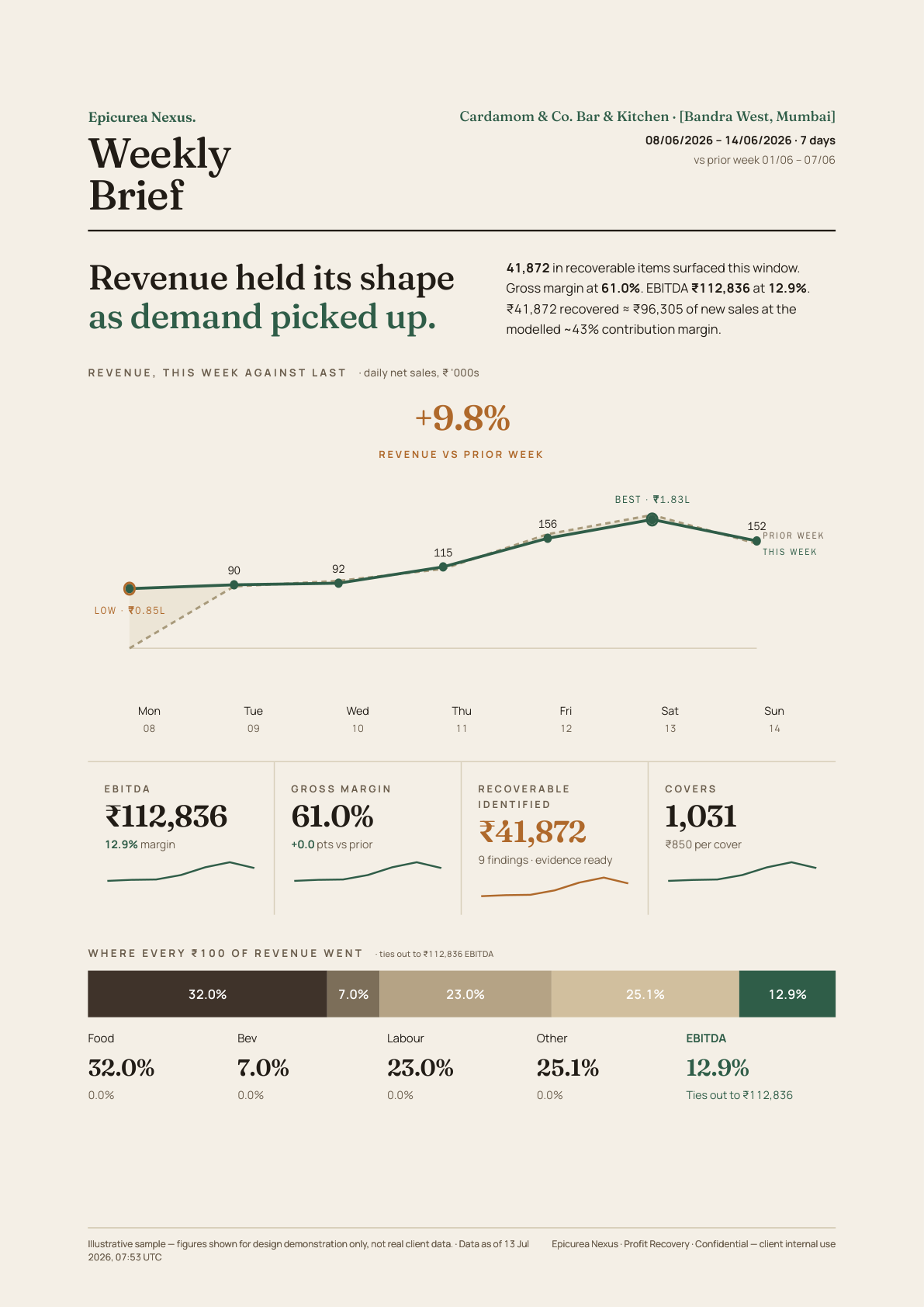
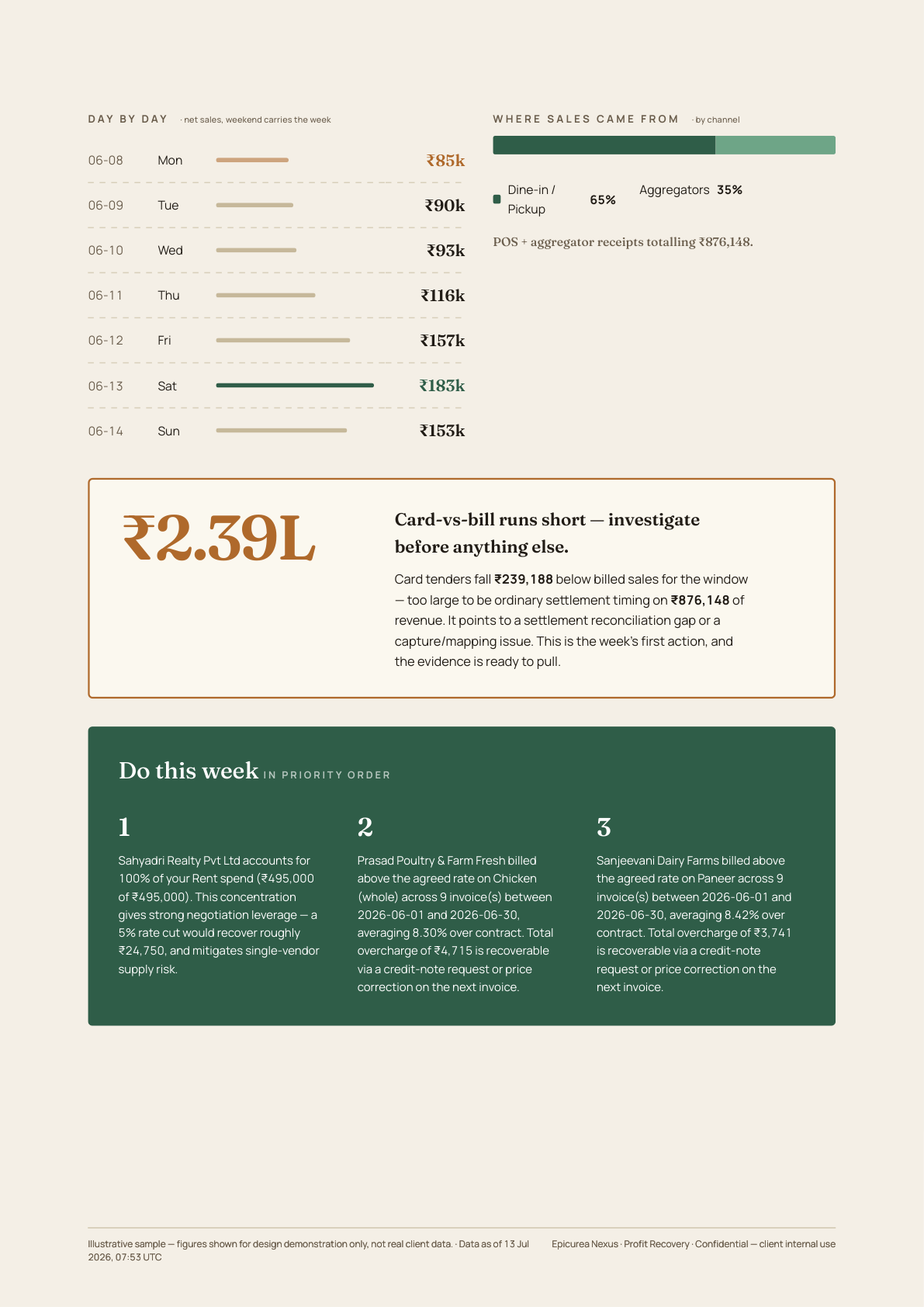
Weekly Brief
A focused editorial brief the owner reads with their first chai. Headline verdict, four KPI stat cards, revenue-vs-prior chart, cost composition, day-by-day, channel mix, a week-over-week Movements panel with an AI briefing, and a reconciliation section that’s honest about what the bank data can and cannot prove.
- Executive verdict + revenue-vs-prior chart
- Gross margin, EBITDA, Recoverable, Covers KPIs
- Week-over-week Movements panel with AI-written briefing
- Reconciliation that shows Unverified when bank data is missing
- Up to three concrete action items with dispute-by dates
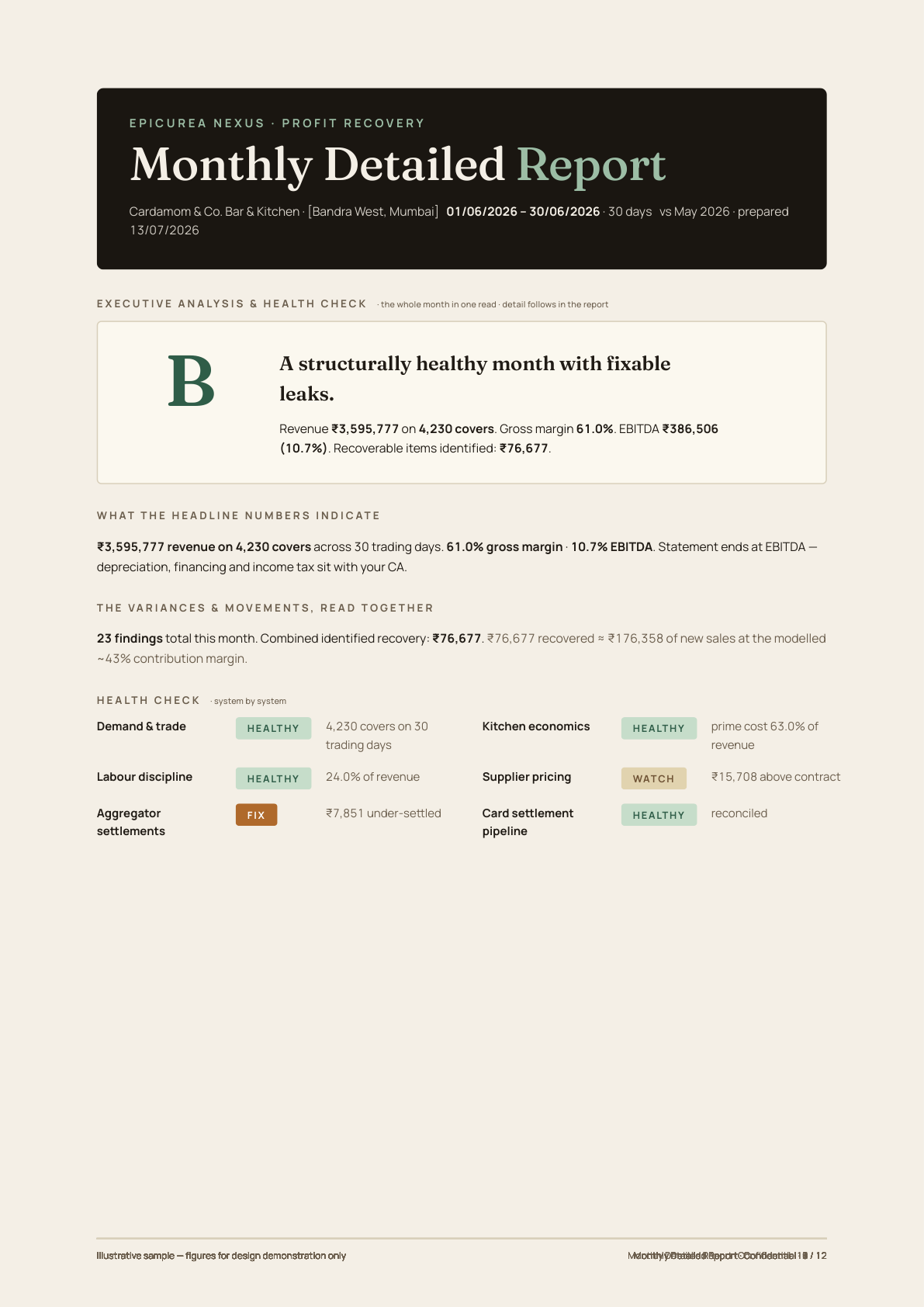
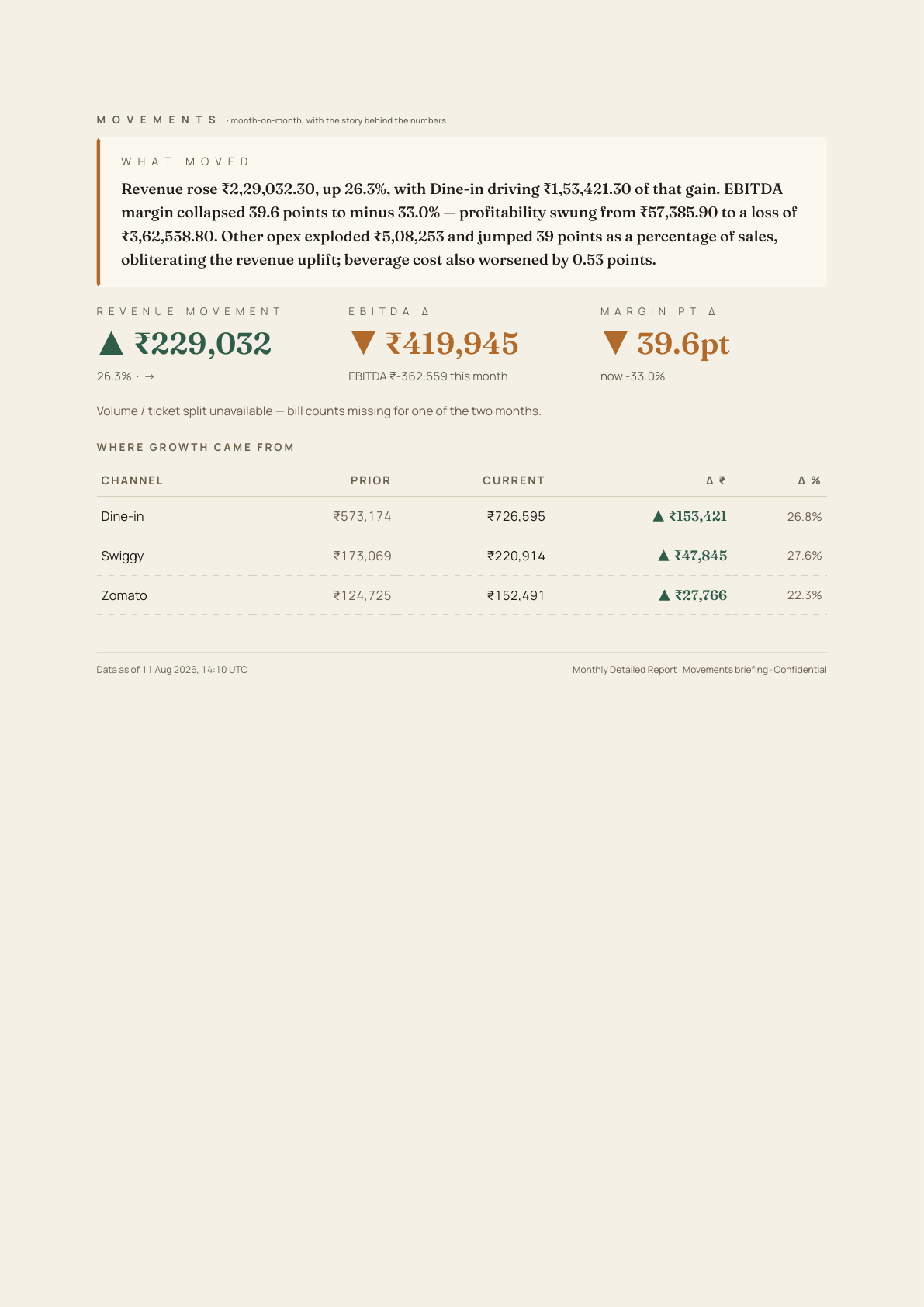

Monthly Detailed Report
A CFO-grade pack: health check, KPIs, cost breakdown, hospitality ratios, a Movements briefing that reads like the analyst wrote it themselves, daily profit calendar, weekday movement & forecast, recoverable table, supplier watch, payment mix, per-platform aggregator summaries, and a four-page appendix (daily detail · P&L ending at EBITDA with a GST memo · 3-way variance · method notes).
- AI-written Movements briefing over the same numbers on the screen
- IFRS-style P&L that ends at EBITDA (with a GST memo)
- MoM movement + forecast with ±1σ band
- Aggregator platform summary sourced from the canonical settlement lines
- Reconciliation with an explicit Unverified state when bank data is not on file
- Method-notes appendix so every number is auditable
Most accountants closeyour books.We close the gaps.
The difference is not effort. It is where you look, and how often.
Quarterly P&L review — variances surface months after the recovery window closes.
Daily 3-way reconciliation (POS ↔ Tally ↔ Bank), down to the individual bill.
No dispute workflow — write-back losses from Swiggy / Zomato just accepted.
Auto-flags wrong commission tiers, promo-leakage, cancelled-but-paid orders.
Generic books. Nothing the owner can read with their morning chai.
Weekly Brief every Monday. Monthly Detailed Report on the 7th. Owner-grade.
A red row with no story. Owner left to guess the cause.
AI variance explainer — every red row gets a one-line root cause.
What the numbers say.
We don't make recovery promises — every engagement is different. What we do is take publicly-known industry realities and apply a financial process to each client's specific books.
Typical EBITDA range for well-run Indian restaurants — every percentage point of leakage matters.
POS data ingestion. We pull and process reports automatically — no daily exports asked of your operator.
Share of restaurant revenue now flowing through aggregators and digital payments — where settlement variances commonly arise.
Weekly Brief lands every Monday. Monthly Detailed Report on the seventh. A cadence you can plan around.
Tailored to each client.Built around four stages.
Every restaurant is different — some need a one-time clean-up before audit, some need an ongoing recovery partner, some need help with menu economics, supplier strategy or pre-investment diligence. Our scope is shaped around what you actually need. What stays consistent is the underlying process.
Onboarding & Connections
We connect to your POS, link Tally through a one-time accountant install, and gather your contracted supplier rate sheets. POS data starts flowing automatically — no daily exports needed from your operator.
Financial Diagnostic
A first deep audit of the last 30–90 days: three-way reconciliation, supplier variance scan, settlement investigation, cost outlier detection. Output is a written findings memo with every recovery candidate quantified.
Active Recovery
Disputes drafted and dispatched in your name — to aggregators, suppliers and banks. We follow up until the cash is back in your account. Concurrently we begin supplier renegotiations, menu economics review and any tailored work your business needs.
Continuous Reporting Cycle
Weekly Brief every Monday at 08:00. Monthly Detailed Report on the seventh. Quarterly business review with you. The engagement compounds — each month's benchmarks make the next month's analysis sharper.
Onboarding & Connections
We connect to your POS, link Tally through a one-time accountant install, and gather your contracted supplier rate sheets. POS data starts flowing automatically — no daily exports needed from your operator.
Financial Diagnostic
A first deep audit of the last 30–90 days: three-way reconciliation, supplier variance scan, settlement investigation, cost outlier detection. Output is a written findings memo with every recovery candidate quantified.
Active Recovery
Disputes drafted and dispatched in your name — to aggregators, suppliers and banks. We follow up until the cash is back in your account. Concurrently we begin supplier renegotiations, menu economics review and any tailored work your business needs.
Continuous Reporting Cycle
Weekly Brief every Monday at 08:00. Monthly Detailed Report on the seventh. Quarterly business review with you. The engagement compounds — each month's benchmarks make the next month's analysis sharper.
Questions owners ask usbefore the first call.
Your CA is built for compliance — filing GST, closing books, signing audit reports. We are built for recovery — finding the cash that has been lost to settlement variances, supplier overcharges, and reconciliation gaps, then actively pursuing it back. Different job, different cadence, different tooling. Most of our clients keep their CA and add us as their financial profit-recovery partner.
Stop guessing where your margin went.Run your restaurant like it has a CFO.
A 30-minute discovery call. We'll listen, ask the questions that surface where the numbers are hiding a story, and tell you whether a Diagnostic engagement makes sense for your operation.